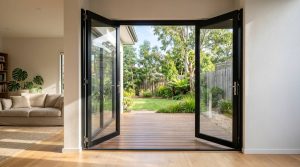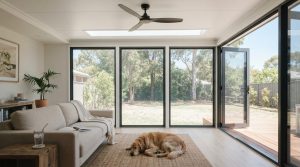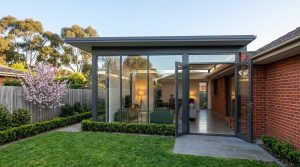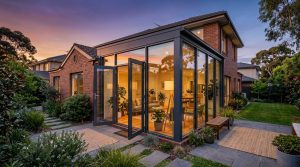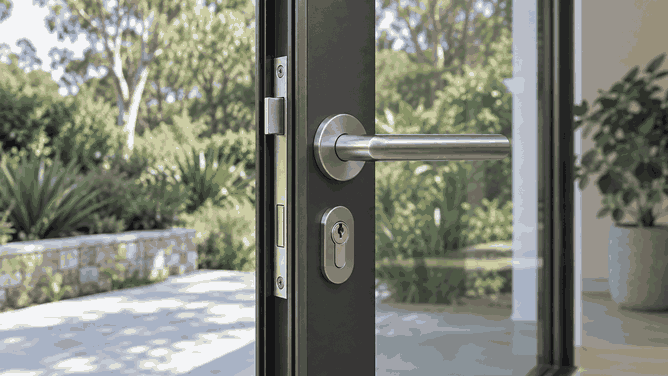
It is a fair question, and it usually arrives in the same shape: a lot of glass, a slim frame, and a worry that the whole thing looks easier to get through than a solid door.
The short answer is that a well-specified aluminium door is hard to force. But the reason is not the one most people expect. The lock is rarely the weak point, so "can I get a better lock?" is the wrong first question. What decides it is the glass, the track, the hinges and the quality of the installation — and those are all specified before anything is made.
How Glazed Doors Actually Get Opened
Forced entry through a glazed door tends to follow a handful of routes, and almost none of them involve defeating a cylinder. Knowing the routes tells you what to ask about.
| Way in | What it relies on | What stops it |
|---|---|---|
| Through the glass | One pane, one impact | Laminated glass. The interlayer holds the sheet together even once it cracks |
| Lifting the panel out | A sliding panel with vertical play in the track | Anti-lift blocks and a properly adjusted track |
| Levering the frame | A single locking point, so the leaf flexes away from the frame | Multi-point locking, which pulls the leaf in at several places |
| Pulling the hinge pins | An outward-opening door with exposed pins | Fixed or non-removable pins, or dog bolts on the hinge side |
| Walking in | The door being unlocked | A lock that is easy enough to use that people actually use it |
Read down the middle column and a pattern appears: every route is about the assembly, not the lock barrel. That is why a premium lock fitted to a door with ordinary glass and a loose track does not buy you much.
The Glass Decides More Than the Lock
There are two kinds of safety glass you are likely to be offered, and for security they behave completely differently.
Toughened glass is heat treated so that when it breaks it falls into small blunt fragments rather than shards. That is excellent for injury safety. It is not much help against entry, because the result is an empty opening.
Laminated glass is two sheets bonded to a plastic interlayer. Hit it and it cracks, but the interlayer holds the pieces in place, so the sheet stays in the frame and has to be worked at repeatedly to get through. If security is the concern, this is the specification that matters.
One point worth being precise about, because it is often blurred in sales material: the Australian standard that governs glass selection in buildings is AS 1288:2021, which replaced the long-standing 2006 edition and is a primary reference in the National Construction Code. It is a human impact safety standard — about people walking into glass — not a security rating. Compliance with AS 1288 tells you the glazing is safe. It does not by itself tell you the door resists forced entry. Those are two different questions, and you should ask them separately.
Multi-Point Locking Is Worth the Difference
A single-point lock holds the leaf at one place, usually the middle. On a tall door that leaves the top and bottom corners free to flex under leverage. A multi-point system throws bolts at several points up the height of the leaf when you lift the handle or turn the key, so there is no easy point to prise.
Worth asking: how many locking points, and are they spread up the full height. On sliding doors, also ask whether the hook bolts engage a keep fixed to the frame rather than just the interlocking stile.
Sliding Doors: the Lift-Out Problem
The classic weakness of a sliding door has nothing to do with the lock. If there is enough vertical clearance, the panel can be lifted up out of the bottom track and swung out at the base, lock still engaged.
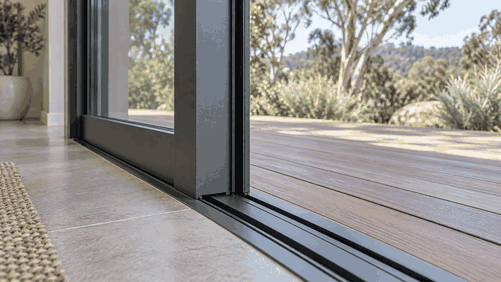
The fix is simple and cheap, which is why its absence is a good test of how carefully a door was put together: anti-lift blocks fitted in the head track, and a track set up so there is no meaningful lift. Ask about it by name. If you are still weighing this style against others, our comparison of sliding doors vs bi-fold doors covers the everyday trade-offs, and the aluminium sliding doors range shows the configurations.
Hinged Doors: Check Which Way They Open
Inward-opening hinged doors put the hinge knuckles inside, which removes the question entirely. Outward-opening doors — common on sunrooms and decks, because they keep interior floor space clear — put the hinges on the outside.
That is perfectly secure when it is done properly, but it has to be done properly: fixed or non-removable hinge pins, or dog bolts that engage the frame on the hinge side so the leaf cannot be lifted away even if a pin is removed. If you are choosing between configurations, see double swing doors, French doors or double hinged doors and the double swing door range.
Installation Is Half of It
This is the part nobody photographs and almost nobody asks about, and it is where otherwise good doors are let down.
A door frame has to be fixed back to structure — stud, lintel, masonry — not simply screwed to the lining of the reveal. Packers behind the fixing points stop the frame from being pulled out of square when it is loaded. Get this wrong and the leaf can be levered along with the frame it is sitting in, regardless of how many locking points it has.
You cannot inspect this after the architraves go on, so ask how the frame is fixed before the job starts rather than after.
Security Screens Are a Different Product
If what you actually want is to leave a door open on a warm night and still be secure, that is a security screen, not a door specification. It is a separate product with its own standards: AS 5039 covers the performance requirements for security screen doors and AS 5040 covers their installation.
Both matter. A screen tested to AS 5039 that is not installed to AS 5040 is a screen that has not been proven in the way that counts. If a supplier quotes one standard, ask about the other.
What to Ask Before You Sign
- Is the glass toughened or laminated, and which panes? Sometimes only the panes at risk of human impact are specified, which is an AS 1288 answer rather than a security answer.
- How many locking points, and where are they?
- On sliders: are anti-lift blocks fitted?
- On outward-opening doors: are the hinge pins fixed, or are dog bolts fitted?
- How is the frame fixed back to structure?
- If a security screen is part of the job, is it tested to AS 5039 and installed to AS 5040?
Six questions. Any supplier who builds doors properly will have quick answers to all of them, and the ones who hesitate have told you something useful.
Frequently Asked Questions
Are aluminium doors less secure than timber doors?
No. Aluminium is stronger than timber at the same profile size, and modern aluminium doors are usually fitted with multi-point locking as standard. The security difference between doors comes from the glass, the locking and the installation rather than the frame material.
Is toughened glass secure?
Toughened glass is a safety product rather than a security product. It breaks into small blunt fragments, which protects people from injury but leaves an opening. Laminated glass is the specification that resists entry, because the interlayer holds the sheet together.
Does AS 1288 mean my door is secure?
No. AS 1288:2021 governs the selection and installation of glass in buildings for human impact safety, and is a primary reference in the National Construction Code. It is not a security rating. Ask about glass type and locking separately.
Can a locked sliding door still be lifted out of its track?
It can if there is enough vertical clearance and no anti-lift blocks fitted. Anti-lift blocks in the head track and a correctly adjusted track remove the possibility, and they cost very little to include.
Are outward-opening doors a security risk because the hinges are outside?
Only if the hinge pins can be removed. Fixed or non-removable pins, or dog bolts engaging the frame on the hinge side, resolve it. Ask which of these is being supplied.
Do I need a security screen as well?
Only if you want to leave the door open and still be secure. That is a separate product with its own standards, AS 5039 for performance and AS 5040 for installation.
Specify It, Do Not Bolt It On Later
Glass type, locking points, anti-lift blocks, hinge pins and frame fixing are all decided before a door is made or installed. None of them is convenient to change afterwards, and none of them costs much at the specification stage. If you are still working out which type of door suits the opening at all, start with choosing a door type by opening width.
You can see completed installations in our project gallery, or contact us for a free measure and quote.
Melbourne Sunroom designs, manufactures and installs custom aluminium doors, windows and sunrooms across Melbourne. Product display available in Point Cook — inspections by appointment only.